
Hays: The Canary in the Coal Mine for the Recruitment Industry?
For decades, permanent recruitment has largely operated through two models: contingent and retained search.
Both have built enormously successful businesses. Both have their place. But I believe we are now witnessing a structural shift in how clients value external recruitment.
LinkedIn reduced the information advantage once held by recruitment firms. At the same time, far more jobs became visible online, allowing candidates to discover opportunities and apply directly without going through an intermediary. Internal talent acquisition teams became larger and more sophisticated, while companies invested heavily in their own sourcing technology and direct recruitment capabilities.
AI is now accelerating the change. It is making candidate identification, research, outreach and screening faster and cheaper. At the graduate and entry level, where companies may receive enormous volumes of applications, technology and AI are increasingly being used to screen, rank and assess candidates before a human recruiter ever speaks with them.
The result is simple.
Finding a CV is no longer as valuable as it once was.
Clients increasingly want something else.
They want judgement.
They want to speak with someone who understands their business, knows their competitors, can explain where the strongest teams sit, understands why one firm is gaining market share while another is losing it, and knows what it will realistically take to attract the best people.
The recruitment industry may be shifting away more from access and towards consultancy/advisory.
And the public markets may already be reflecting that change.
Two Very Different Models
Retained search has traditionally depended heavily on the consultant’s understanding of a client’s business and market.
A good search consultant needs to understand not only who the candidates are, but where to find them and why.
Which companies are genuinely strong in a particular business?
Which competitors are gaining market share?
Which teams are under pressure?
Who is actually driving revenue?
Which individuals might move, and what would persuade them?
But the best consultants go a step further.
Sometimes there is no mandate.
A consultant may meet an exceptional individual and immediately recognise that they could add significant value to a particular client. Not because a job description happens to match their CV, but because the consultant understands the client’s business well enough to see the opportunity.
Perhaps the candidate could open a new market, strengthen an underperforming team, bring relationships the client does not currently have, solve a succession problem or build a capability that is missing altogether.
In those situations, the consultant is not filling a vacancy. They are identifying an opportunity.
That requires a very different level of understanding. You need to know the client’s strategy, strengths, weaknesses, competitive position and ambitions well enough to say: “You may not be hiring for this today, but I believe you should meet this person.”
The value proposition is not simply: “I know a candidate.”
It is: “I understand your business, I understand the market, and I can recognise value even before a formal hiring need exists.”
The large contingent recruitment firms grew differently.
Many built extraordinarily successful global businesses around scale, activity and tightly managed KPIs. Calls made. Candidates registered. CVs sent. Client meetings. Interviews arranged. Placements made.
I have enormous respect for what firms such as Hays, PageGroup and Robert Walters have built. They are mammoths of our industry and achieved global scale at remarkable speed.
But the model has always had a weakness.
When activity becomes the objective, activity can replace judgement.
Anyone who has worked in a large recruitment market will recognise the behaviour this can create.
A consultant approaches Friday afternoon with a CV send target to hit. Suddenly, a rush of marginally relevant resumes goes out to clients. Internal HR teams are left registering and reviewing candidates who were never genuinely on spec. Ten CVs are sent in the hope that one produces an interview.
Throw enough spaghetti at the wall and hope some of it sticks.
That is, of course, a generalisation.
There are outstanding contingent recruiters with exceptional market knowledge. I have worked with and competed against many of them.
But in a heavily KPI driven environment, market knowledge does not always keep you in your seat.
Hitting your numbers does.
The Perfect Storm
I believe the traditional contingent model is now facing a perfect storm.
The first major disruption was LinkedIn.
Twenty years ago, knowing who worked at a competitor was valuable information. Recruiters spent years building proprietary databases and personal networks.
Today, much of that information is publicly available.
Then came the rise of internal talent acquisition. Companies built sophisticated in-house teams with direct access to sourcing technology, professional networks and increasingly powerful internal databases.
And now we have AI.
AI can already help identify target companies, map markets, generate search strings, research candidate backgrounds, draft outreach and compare resumes with job descriptions.
These capabilities will improve dramatically.
The implication for recruitment is uncomfortable but unavoidable.
Access is becoming commoditised.
If a client can identify 100 potential candidates using LinkedIn, an internal sourcing team and AI, why pay an external recruiter simply to identify another 100?
The value has to move somewhere else.
I believe it is moving toward judgement, calibration, market intelligence, credibility, confidentiality, candidate assessment and the ability to persuade someone who is not actively looking for a job to seriously consider a move.
Is the Public Market Already Pricing the Shift?
This is where the argument becomes particularly interesting.
If the pressure on recruitment were simply cyclical, we might expect recruitment firms broadly to move together.
Hiring slows, recruiters suffer.
Hiring recovers, recruiters recover.
But since 2023, the market picture appears more divided.
The following is an indicative comparison of listed firms whose business models provide a reasonably relevant contrast. I have excluded private executive search firms because no public share price data exists. I have also excluded broad staffing conglomerates where temporary labour and workforce solutions make the comparison less direct.
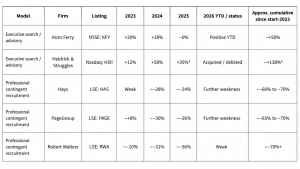
Heidrick & Struggles’ 2025 performance was materially affected by its acquisition. The company agreed to a $59-per-share take-private transaction and ceased trading following completion in December 2025.
The figures above are rounded and intended to illustrate broad share-price direction rather than total shareholder return. Dividends are excluded, currencies differ, and exact returns vary depending on trading dates and whether adjusted or unadjusted prices are used. The table should not be interpreted as proof of causation.
Even with those caveats, the divergence is difficult to ignore.
Korn Ferry has shown considerable resilience. Heidrick & Struggles delivered very strong shareholder returns before being taken private, although the acquisition premium clearly contributed to its final-year performance.
Meanwhile, Hays, PageGroup and Robert Walters have experienced severe share price declines.
These are not obscure businesses. They are among the most recognised recruitment brands in the world.
That is precisely why the divergence deserves attention.
The public market is not necessarily telling us that recruitment is dying.
It may be telling us that different forms of recruitment are being valued very differently.
Hays: The Canary in the Coal Mine?
Perhaps the most striking example is Hays.
For decades, Hays represented one of the great success stories of global recruitment. It built a powerful international brand and a presence across dozens of markets.
But the company is now materially reshaping its footprint.
In June 2026, Hays sold operations in six European countries: the Czech Republic, Denmark, Hungary, Luxembourg, Romania and Sweden.
It has also been reported to be exploring options for businesses in Belgium, Brazil, Greater China, Malaysia, the Netherlands, Singapore and the UAE, following earlier exits from other markets.
This matters.
It would be easy to present these decisions as evidence that Hays is failing. I do not believe that is fair.
Rationalising underperforming operations may be exactly the right strategic decision. Hays remains a major company with a powerful brand and significant expertise.
But the retrenchment raises a larger question.
If one of the most successful global recruitment firms of the modern era is dramatically narrowing its geographic footprint, are we looking at a normal cyclical downturn, or something more structural?
That question becomes harder to dismiss when we look across the wider sector.
PageGroup and Robert Walters have also experienced significant pressure. Permanent hiring has been particularly difficult. Client and candidate confidence has remained weak.
Perhaps the market will simply recover.
But perhaps the market itself has changed.
The Real Shift May Not Be Retained Versus Contingent
There is an obvious challenge to my argument.
Correlation is not causation.
A stock price table cannot prove that clients are abandoning contingent recruitment for retained search.
Korn Ferry is not simply an executive search firm. It has built a substantial organisational consulting and advisory business.
Heidrick & Struggles also expanded beyond traditional search into leadership advisory, consulting and on demand talent.
The listed contingent firms have different geographic exposures, sector mixes and business models.
So it would be simplistic to look at a share price chart and declare that retained search has defeated contingent recruitment.
I think the deeper shift may be more interesting than that.
Perhaps clients are not simply moving from contingent to retained.
Perhaps they are moving from transactional recruitment to advisory led recruitment.
A client does not necessarily care whether a search is labelled “retained” or “contingent.”
They care whether the recruiter adds value.
Can the recruiter explain the market?
Can they challenge the brief?
Can they tell the client that the person they think they need probably does not exist at the compensation level they have budgeted?
Can they explain which competitors have the strongest teams and why?
Can they identify candidates who are not actively looking?
Can they distinguish between someone who interviews well and someone who actually performs?
Can they tell a client something the client does not already know?
That is where I believe value is moving.
What I See in My Own Business
I have worked in recruitment for more than 20 years and founded my own firm in 2012.
The most valuable conversations I have with clients today are increasingly not about whether I can send a resume.
They are about the market itself.
Which competitor is building?
Which team is losing people?
Who genuinely drives revenue?
Why is one platform outperforming another?
What is a realistic compensation package?
Which candidate could actually be persuaded to move?
Where are the hidden succession risks?
Which person looks impressive on paper but is unlikely to succeed in a particular culture?
These are not sourcing questions.
They are advisory questions.
And this is where recruitment firms need to be honest with themselves.
If your value proposition is based primarily on access to names, technology is coming directly for your competitive advantage.
If your value proposition is based on judgement, relationships, credibility, persuasion and genuine market expertise, technology may actually make you more valuable.
AI can help a knowledgeable recruiter become dramatically more productive.
But AI cannot magically give an inexperienced recruiter 20 years of context.
It cannot automatically create trusted relationships with candidates who are not looking to move.
It cannot replace the credibility required to tell a senior client that their assumptions are wrong.
It cannot easily understand why a candidate who appears perfect on paper may fail in a particular organisation.
At least, not yet.
So, Is the Game Up?
Perhaps “the game is up” is too strong.
The large contingent firms will not disappear. They have powerful brands, huge client relationships, enormous databases and significant resources. Many will adapt.
Some already are.
But I do believe the economics of recruitment are changing.
AI will make candidate identification faster and cheaper. LinkedIn will continue to make professional information more accessible. Internal talent acquisition teams will become more sophisticated.
Clients will continue to question why they should pay external fees for work they can increasingly perform themselves.
None of these trends is likely to reverse.
That creates an uncomfortable question for any recruitment firm whose primary value proposition remains access to candidates.
If everyone can find the names, what exactly is the client paying you for?
I believe the answer will increasingly be judgement.
The firms that understand their clients deeply, know the competitive landscape, build genuine expertise and can advise rather than simply transact will continue to have a role.
Perhaps an increasingly valuable one.
The firms that remain dependent on volume, activity and information asymmetry may find the next decade considerably more difficult than the last.
The recruitment industry is not disappearing.
But the value within it is moving.
From access to advice.
From activity to judgement.
From sending CVs to solving problems.
And the public markets may already be telling us that this shift has begun.